Storing R, or recomputing it from V
When column \(j\) of \(R\) is needed to cancel a pivot, there are two ways to get it.
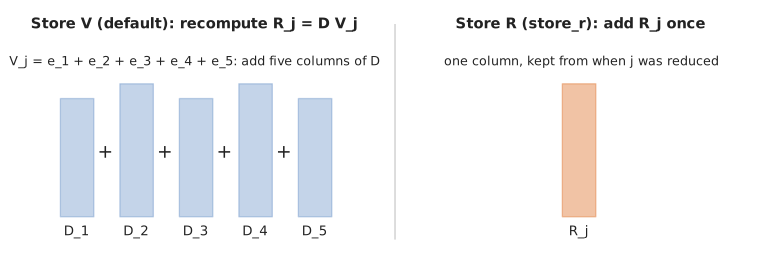
Store V, recompute R (the default)
\(V_j\) is stored (sparse), and \(R_j = D V_j\) is rebuilt by adding the column of \(D\) for every term of \(V_j\). This is what Ripser does.
- Good when \(V\) stays short: for Vietoris–Rips cohomology almost every pair is apparent, \(V_j = e_j\), and “recomputing” \(R_j\) is just generating one column of \(D\), which the oracle does cheaply.
- Memory-light: \(V\) is usually much sparser than \(R\), and the columns of \(D\) are never stored.
- Bad when \(V\) gets long: on dense matrices or cubical complexes a column of \(V\) can have hundreds of terms, and every use of \(R_j\) re-adds hundreds of columns of \(D\).
Store R (store_r)
Clearing::new().store_r(true) keeps each reduced column \(R_j\) (from its pivot down) when it is first reduced, for
the rest of its dimension, and adds it as one column. This is what PHAT does.
- Good when columns need many additions: dense boundary matrices, cubical complexes, homology of cell complexes. On those it is several times faster.
- Bad for memory when \(R\) is much denser than \(V\).
- No gain for Vietoris–Rips cohomology, where almost nothing is reduced.
Apparent pairs and columns that needed no reduction are still never stored: their \(R_j = D_j\) comes straight from the oracle.
Not tracking V at all
When only the diagram is wanted (no representatives), and \(R\) is stored, nothing needs \(V\), so Clearing’s
diagram() doesn’t track it. On dense matrices building \(V\) was most of the remaining work.
Who uses what
| default | |
|---|---|
phlite (Rust) | store V |
phlite_rips, phlite_grpph | store V |
phlite (Python, explicit complexes) | store R (serial clearing) |