Representatives and the involution
A representative of a bar is a cycle that is born at the bar’s birth and (for a finite bar) becomes a boundary exactly at its death.
From homology: for free
Reducing the boundary matrix gives them directly:
- for a pair \((b, d)\), column \(d\) of \(R = DV\): a cycle with pivot \(b\) that is the boundary of \(V_d\), a chain present at \(d\);
- for an essential class born at \(b\), column \(b\) of \(V\): a cycle (\(R_b = 0\)) with leading term \(b\).
From cohomology: the involution
Cohomology is usually much faster, but its reduction gives cocycles. To get cycles,
barcode::cohomology_with_involution uses Čufar’s involuted persistence:
- Compute the pairs by cohomology, as fast as usual.
- Run a homology reduction on the boundary matrix (the coboundary’s transpose), but only of the columns that matter: the death cells of finite bars and the birth cells of essential bars.
- Read representatives off that small reduction’s \(R\) and \(V\), as above.
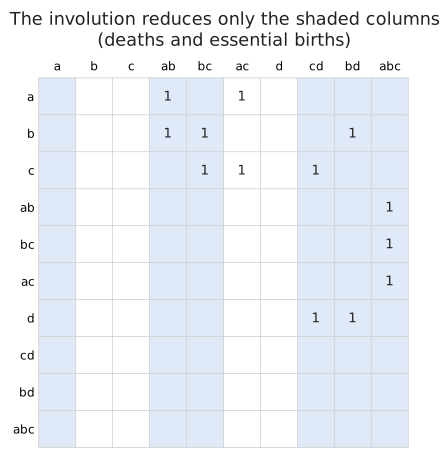
For the running example only six of ten columns are reduced: the deaths ab, bc, cd and abc, and the essential births a and bd.
Why is that enough? Reducing a column only ever adds earlier columns that own a pivot, and every column that owns a pivot is a death, so the death columns are closed under the reduction. Zero-length pairs are deaths too, and may be missing from the diagram (they are skipped), so this reduction keeps apparent pairs switched on: their owners are recognised through the coboundary, without being in the basis.
Costs and trade-offs
- Good when bars are few compared with cells, as is typical: the second reduction touches only the death columns, and nearly all of those are apparent pairs that need no work.
- Costs a homology reduction, which can be the slow direction, and needs the transpose (the boundary) to be available. On filtrations with very many bars (random point clouds in high dimension) it can cost as much as the cohomology itself.
- The reduction in step 2 uses a restricted basis, so it must not assume that every column is in the basis: in
particular phlite_py’s single-lookup pivot table (
full_basis) is switched off for it (see bookkeeping). A bug where it wasn’t was found by the fuzz tests.
Representatives in phlite are reported as lists of (cell, coefficient) in decreasing filtration order, so the
birth cell comes first.