Homology or cohomology?
There are two matrices you can reduce to get the same barcode.
- Homology reduces the boundary matrix \(D\): columns are cells, entries are their faces.
- Cohomology reduces the coboundary matrix: columns are cells, entries their cofaces. Put in the right order (both cells and cofaces in reverse filtration order) this is the anti-transpose \(D^\perp\) of \(D\).
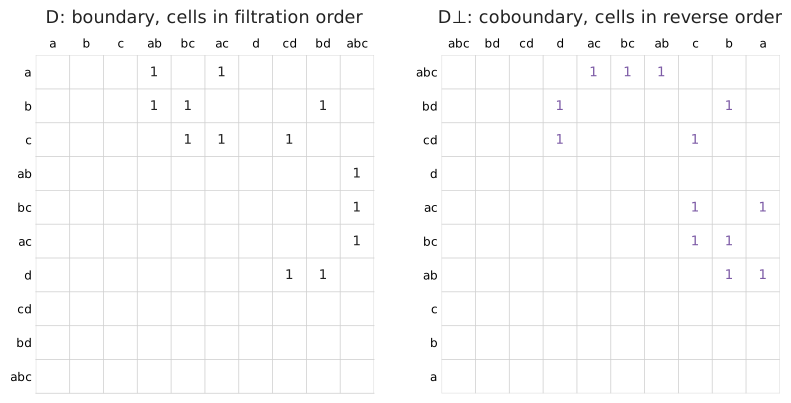
The anti-transpose flips D about its anti-diagonal: rows and columns swap, and both are reversed.
The pairs of \(D^\perp\) are exactly the pairs of \(D\), with birth and death swapped (de Silva, Morozov and
Vejdemo-Johansson). So phlite reduces whichever is cheaper and reports bars in homology conventions either way.
Why cohomology is usually faster
Ripser popularised cohomology because, combined with clearing, it does far less work on filtrations that grow quickly with dimension, like Vietoris–Rips:
- Clearing works in the cheap direction. With cohomology the dimensions are reduced from low to high, and the pairs found in dimension \(d\) clear columns of dimension \(d + 1\), the larger dimension, which has by far the most columns. With homology the pairs clear columns of the smaller dimension.
- No need to enumerate the top dimension. To compute \(H_d\) by cohomology you need columns only up to dimension \(d\); the cells of dimension \(d + 1\) appear only as rows, produced lazily as cofaces. Homology needs every \((d+1)\)-cell as a column. For Rips in dimension 2 that is the difference between enumerating the triangles and enumerating the tetrahedra.
- Apparent pairs are found from the cheap end. Most columns of a Rips coboundary are finished by emergent pairs without being built.
When homology is better
- When you want representatives cheaply. Homology gives cycle representatives directly (columns of \(R\) and
\(V\)). Cohomology gives cocycles;
phlitegets cycles from a cohomology computation with a second, much smaller reduction, the involution, which costs extra. - When columns of the boundary are short and the complex is not much bigger in the next dimension. For explicit cell complexes and some cubical complexes the two are close; in the benchmarks homology was about 7% faster on a cubical complex of random noise, but slower on the others, and about 3× slower on random cell complexes.
- For relative cohomology you can reduce \(D\) in the other direction:
phlite’sreverseadaptor gives the anti-transpose of any matrix.
Every barcode function and Python package takes a method ("cohomology" by default, or "homology").