Sorted columns
SortedColumns keeps the working column as one vector, sorted ascending, so the pivot is the last entry.
Columns added are collected unsorted; at the next pivot query they are sorted together (they are usually few and
short) and merged in, starting from their smallest entry: everything below that stays where it is.
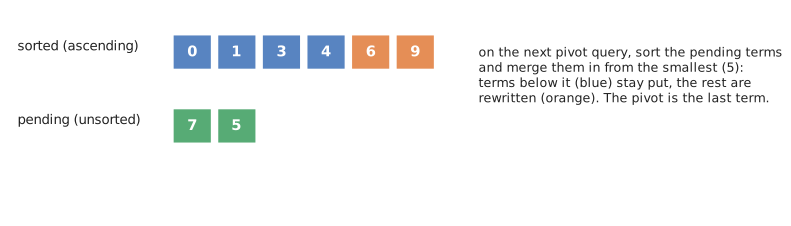
The merge works by position over two slices, which compiles to a tight loop. (An earlier version merged through iterator adaptors and kept its state in memory, which made it twice as slow; the benchmarks caught it.)
Good
- When the columns added stay close to the pivot, so each merge only rewrites the top of the vector: typical of homology of simplicial and cell complexes, where it is the fastest representation (about 1.5× faster than merged columns on Rips homology), and of small dense matrices.
Bad, sometimes very bad
- When the columns added reach far below the pivot: each addition then rewrites nearly the whole working column, so the cost grows with its length. On GrPPH and on the cohomology of cubical complexes it is 15–35× slower than merged columns, and on structured Vietoris–Rips it can take hours where the others take seconds.
Only use it after measuring it on your matrices.