Pivot columns
PivotColumns is PHAT’s bit_tree_pivot_column: the working column is a dense array with a slot for every row,
plus a 64-ary tree of bitsets saying which slots are in use.
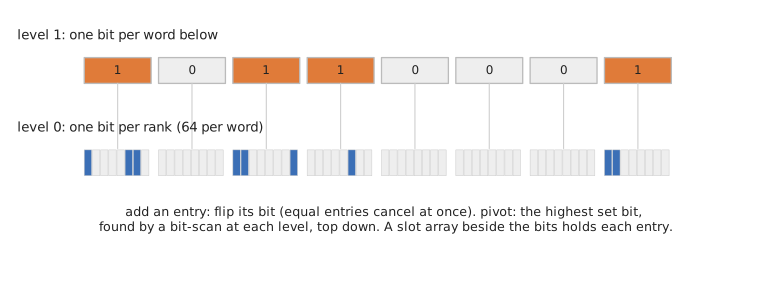
Level 0 has a bit per row (by rank); each bit of level 1 says whether a word of level 0 is non-zero. Three levels cover 262,144 rows, four cover 16 million.
- Add an entry: write it into its slot and flip its bit. Over Z/2 equal entries cancel at once, by the flip. The upper levels only change when a word becomes empty or non-empty.
- Pop the pivot: the highest set bit, found by one bit-scan (a single instruction) per level, from the top down.
This needs the rank of every row in filtration order, so a matrix provides it with row_ranks; for matrices that
don’t, pivot columns fall back to merged columns. (The Python bindings refuse 'pivot' there rather than silently
merging.)
Making it fast
Profiling turned up three things worth knowing, all specific to Z/2:
- Branchless flips. “Is this row already present?” is a coin toss on dense columns, which the CPU mispredicts
constantly. Since a field with one non-zero element is Z/2,
phlitedetects it at compile time (the coefficient type is zero-sized) and flips the bit unconditionally, writing the slot whether or not the entry ends up present. That cut dense 400 × 400 matrices from 28 ms to 11 ms. - Flipping a word at a time. Entries arrive sorted, so neighbours share a 64-bit word; gathering their flips and applying them together avoids each flip waiting on the last one’s write (dense: 8.8 → 7.3 ms).
- No rank lookups. When rows are already numbered by rank (as for explicit complexes),
RowRanks::identityskips the table entirely.
Good
- Many columns added to each, as for explicit dense or cubical complexes, especially with stored R:
1.4–5× faster than merged columns there, and the default for explicit complexes in the Python
phlitepackage.
Bad
- Every entry added is visited: nothing below the pivot is skipped, unlike merged columns.
- A slot for every row, allocated once per reduction: fine for explicit complexes, impossible for Vietoris–Rips (where rows are simplices labelled by huge sparse indices).
- Only serial clearing reuses one working column; the standard and parallel algorithms make a fresh column per column, and use merged columns instead.