Clearing
Clearing (Chen and Kerber’s “twist”) uses a fact about the pairs: if \((i, j)\) is a pair, then cell \(i\) gives birth to a class, so column \(i\) of \(R\) will be zero. There is no need to reduce it.
So reduce the dimensions in the right order and every pair found in one dimension clears a column of the next:
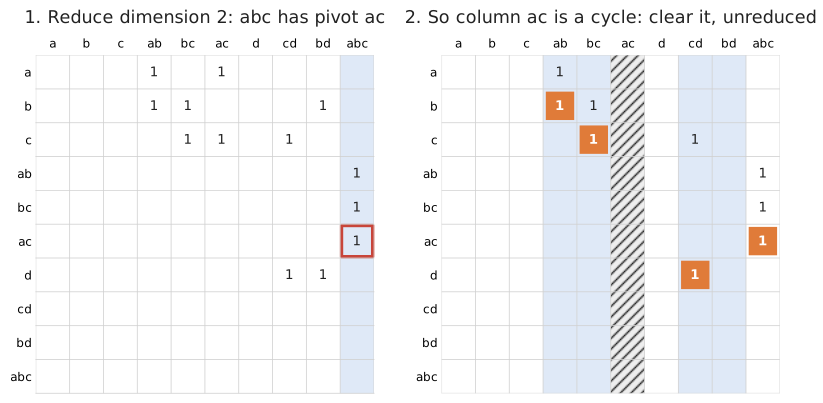
Homology of the running example. Reducing dimension 2 pairs ac with abc, so column ac (hatched) is set to zero without being reduced. Its reduction would have taken two additions.
phlite::reduction::Clearing does this dimension by dimension:
flowchart TD
    S["for each dimension d (in the matrix's direction)"] --> C{"column j paired<br/>in the previous dimension?"}
    C -- yes --> Z["cleared: R_j = 0,<br/>V_j = the other column of R"]
    C -- no --> P{"pivot unclaimed?"}
    P -- yes --> F["finished without building<br/>(emergent / apparent pair)"]
    P -- no --> RED["reduce the column"]
    RED --> REC["record the pair or the birth"]
    F --> REC
    Z --> N["next column"]
    REC --> N
The direction is detected from the matrix: for a boundary matrix the pivots of dimension \(d\) lie in dimension
\(d - 1\), so dimensions are reduced from the top down; for a (reversed) coboundary from the bottom up. You can fix it
with with_dimension_order.
For representatives the cleared column still needs a \(V\) column; it is \(R_j\) of the column it was paired with,
which phlite keeps a reference to rather than copying (ClearedReductionMatrix).
When it helps
- Almost always. It saves the reduction of every column that gives birth to a class which later dies, which is often the most expensive kind.
- Most with cohomology: the cleared columns are then the cells of the higher dimension, by far the most numerous (see Homology or cohomology?).
When it doesn’t
- It needs the column basis split by dimension (
HasSplitColBasis). - With homology the cleared columns are in the smaller dimension, so it saves less.
- The pairs of each dimension are kept until the next dimension is done, a little memory.
Clearing is also the framework the other tricks plug into: apparent and emergent pairs, storing R and the parallel version all build on it.